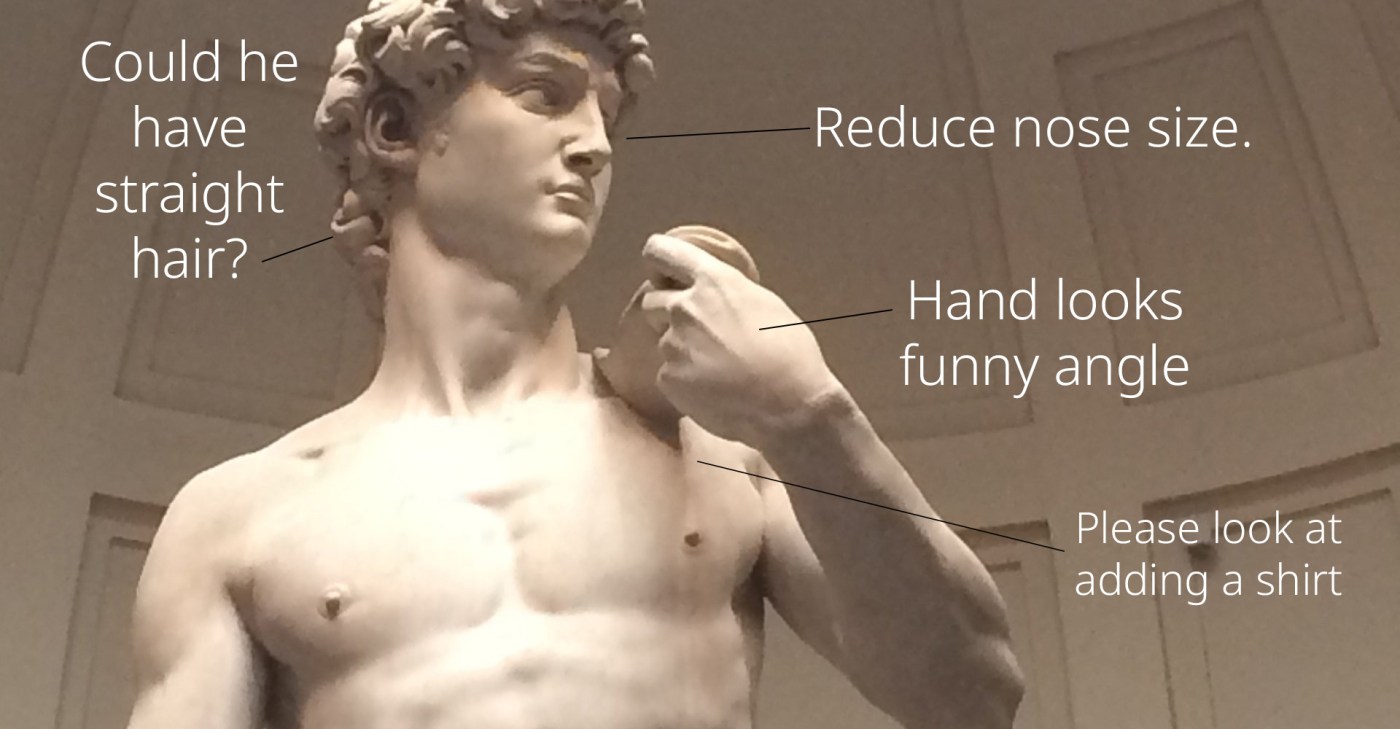
One of the hardest things in our job is to accept client changes.
We all have had to attend meetings, where we have to dutifully write down the client comments on how a concept could be improved, taking in all the feedback, and thanking them for their input.
I have mixed feelings about this and not all of them bad ones. On one hand feedback is helpful, it makes you think about your work from a perspective you hadn’t considered. It doesn’t make it right or wrong, but it gives you the opportunity to pressure test your own thinking.
On the other hand, just because it was a client comment doesn’t make it some precious wisdom written down on ancient scrolls from some mystical oracle on a mountainside that must be adhered to on pain of death.
(I remember once, at an agency I was at early on in my career, we had a funny comments board. ( Before social media obvs) and the one that stood out to me and still makes me smile was from a contact report. It was something like “Client rejected his own changes he’d demanded the week before’.)
What I am hoping for is a healthy debate, a scrutiny of the idea, an interrogation of how communication works. Is the concern legitimate? are we second guessing the target market? Does this image really remind anyone else of a prison camp?
That’s what makes work better and all clients want that, don’t they?
That is collaboration.
We can sometimes agree and we can sometimes challenge those comments, or we can downright disagree (although risk being labelled as un-collaborative) it just has to be an opinion that can be debated openly.
More typically these days, we have to find compromises that we can live with. Which is always somewhat deflating but comes with the pharma category, certainly when medical and legal gets involved.
However, I will let you into a secret; it’s not always about the changes. It’s about the client feeling heard.
Yes, they may have legitimate concerns about legal or claims or even creative suggestions that in their opinion improves the work but more often its about them having ‘input’.
The following anecdote about Michelangelo’s ‘David’ found its way onto my facebook feed. It all occurred over 500 years ago but it has a familiar ring to it.
In 1504, as he completed this renowned statue, high-ranking officials of the Florentine Republic attended the inauguration to admire the over four-meter-tall masterpiece. Among them was Pier Soderini, a notable patron of the arts.
Soderini, perhaps wanting to display his expertise, remarked to Michelangelo that while “David” was beautiful, he believed the nose was disproportionate and suggested it be slightly reduced to enhance its artistic value. Michelangelo, known for his pride and sensitivity, refrained from reacting angrily to avoid causing a political incident.
Instead, Michelangelo devised a clever solution. He agreed to alter the nose but secretly collected marble dust and small fragments. Ascending the ladder with hammer and chisel, he pretended to chisel the nose while subtly dropping the dust and fragments. This created the illusion of modification.
The spectators, convinced by the falling debris, believed the nose had been adjusted. Soderini himself declared the statue perfect after the “adjustment.”
“David,” a symbol of Florence, remains a masterpiece and a testament to Michelangelo’s genius, which clearly needed no artistic advice.
Now, I don’t recommend this use of ‘smoke and mirrors’ to be used too liberally but I’ve seen it used in agencies a few times.
‘Don’t make any changes, send it back to them and see if they think that is better.’
I’ve also seen it work.
My advice is this:
Take the time to really understand why they want that change made. As Peter Souter says, say to yourself ‘how interesting’ and be intrigued as to their reasoning.
Pretty often what they are trying to achieve is different to the change they are requesting.
In other words, the problem may not be that the nose of David is too big, but that the face is too short.
Your job as a creative is to be the expert in the room, not the remote hand of someone who has no artistic or literary skills whatsoever. That way lies ruin.
Happy chiselling.
 ollycaporn's blag
What do you think about this blog? Leave a comment!